
Posted by Ashok Munot
Filed in Business 5 views
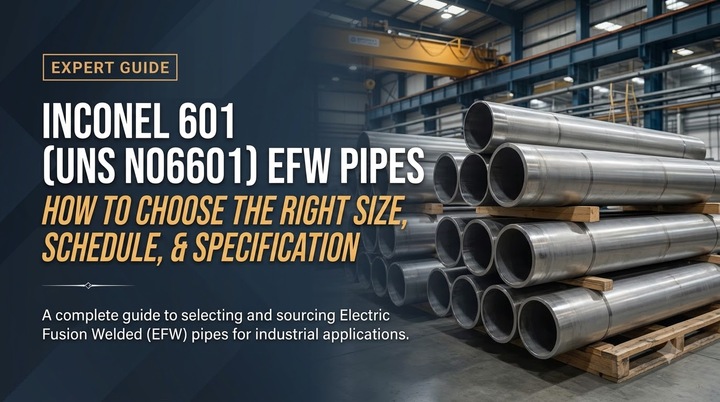
Pipe selection requires more than just choosing a base alloy. Specifying the exact diameter, wall thickness, schedule, and manufacturing specification directly impacts safety, service life, and overall project cost. Engineers frequently specify Inconel 601 (UNS N06601) EFW Pipes because this nickel-chromium metal resists high-temperature oxidation and severe corrosion. Proper physical sizing ensures the entire plant system functions reliably under continuous thermal stress.
Evaluating the designated operating pressure and maximum service temperature helps engineers determine the physical limits of the system. Fluids containing corrosive media demand materials that will not degrade prematurely.
Internal pipe dimensions must support specific flow requirements without causing excessive fluid friction. External forces from structural supports apply continuous mechanical loading to the metal.
The chosen field installation method dictates how joints are prepared and welded. Ignoring these technical parameters often leads to premature failures in an Electric Fusion Welded Inconel Pipe network. Engineers evaluate these details carefully.
Specifying required dimensions begins with the standard Nominal Pipe Size. This measurement defines the fixed Outside Diameter.
Wall Thickness dictates the actual internal diameter available for moving fluids.
The internal opening controls flow capacity and directly influences the calculated pressure drop across the entire system.
Complex facility layouts frequently impose strict space limitations that heavily restrict pipe routing options.
Any newly ordered UNS N06601 EFW Pipe must align exactly with existing piping systems to permit safe field welding.
The designated Inconel 601 Pipe Schedule indicates the specific wall thickness for a given outer diameter. Standard schedules used in plants include SCH 10, SCH 40, SCH 80, and SCH 160.
SCH 10 provides a thin wall suitable for low-pressure processes. SCH 40 acts as a standard size for general facility piping. SCH 80 and SCH 160 contain much thicker metallic walls.
Selecting higher schedules directly increases the maximum pressure capability of the Nickel Alloy 601 Pipe. Thicker walls increase overall unit weight and base procurement costs.
|
Pipe Schedule |
Typical Wall Thickness |
Pressure Capability |
Common Applications |
|
SCH 10 |
Thin |
Low |
Exhaust systems |
|
SCH 40 |
Standard |
Moderate |
Process piping |
|
SCH 80 |
Extra Heavy |
High |
High-pressure lines |
|
SCH 160 |
Double Extra Heavy |
Very High |
Severe service |
Buyers must review technical documents carefully. The requested specifications must match the approved project drawings and standard industry requirements before material fabrication actually begins.
The ASTM B517 Inconel 601 Pipe standard dictates basic physical properties. The ASME SB517 Pipe code ensures materials withstand extreme internal pressures without failing under continuous intense industrial thermal stress.
Manufacturing tolerances define acceptable deviations in pipe thickness. Exact dimensional standards ensure the physical pipe matches standardized fittings to avoid expensive physical mismatches during complicated final plant assembly and welding.
Quality control demands material traceability via stamped heat numbers. Proper heat treatment relieves residual stresses left by welding and restores optimal microstructural stability to the Inconel 601 Pipe Specification material.
Inspection certificates provide documented proof that pipes passed hydrostatic testing. Specific internal surface finish requirements prevent microscopic contamination and reduce the exact locations where severe localized corrosion might rapidly initiate.
Industrial process parameters dictate metallurgical choices. Alloy 601 EFW Pipe performs well in furnace applications due to its inherent resistance to severe high-heat oxidation.
Continuous extreme heat weakens standard piping over time. Rapid heating and cooling cycles create massive thermal expansion stresses. Engineers specify this alloy to maintain structural integrity during aggressive temperature changes.
Oxygen causes destructive physical scaling at elevated temperatures. Chemical plants process highly reactive fluids daily. This nickel alloy forms a tightly adhering protective oxide layer, preventing rapid localized pitting failures.
Complex designs involve extensive pipe bending. Fabrication requires materials that operators can join safely. Evaluating the expected service life ensures the initial investment prevents unexpected maintenance shutdowns over the coming operational decades.
Procurement teams sometimes overlook critical engineering details during rush orders. Missing specific technical requirements leads to rejected material deliveries and extensive plant construction schedule delays.
Purchasing departments often select materials solely by outside diameter without checking internal pressure ratings.
Ignoring specific schedule requirements results in pipes that cannot handle the internal process pressure safely.
Choosing an incorrect ASTM specification causes major compliance failures during final plant safety inspections.
Overlooking required testing documentation creates immense problems for quality control departments during material receiving.
Not confirming exact dimensional tolerances leads to pipes that fail to align with existing flanges.
Buying cheap materials without considering future maintenance costs ruins long-term operational maintenance budgets.
Selecting the correct physical size, precise schedule, and exact specification ensures long-term system reliability, operational safety, and overall cost efficiency. Engineers must review all complex technical requirements before initiating procurement steps. Buyers should source components from recognized suppliers offering complete dimensional ranges and fully certified material testing documentation.