
Posted by Mahesh Ranka
Filed in Business 6 views
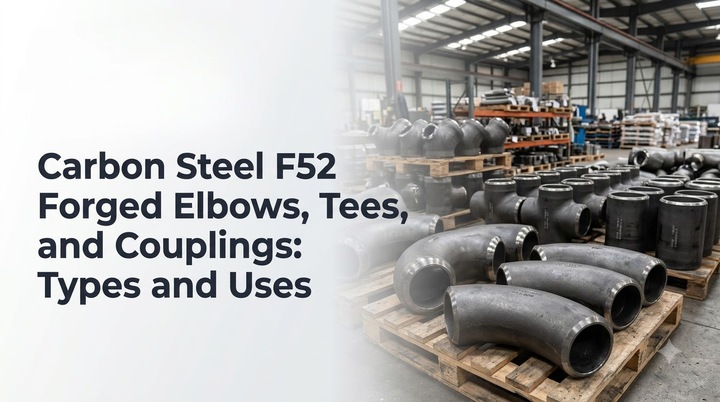
Engineers specify Carbon Steel F52 Forged Fittings for high-pressure transmission lines and industrial process piping. The material complies with the A694 specification. This grade yields a minimum of 52,000 psi. The manufacturing process uses solid steel blocks. These are heated and shaped under extreme pressure. Forging compresses the grain structure, which improves the mechanical strength and eliminates internal voids. Systems with high stress rely on Carbon Steel Forged Fittings to prevent leaks. The standard covers various components. You will find elbows, tees, and couplings in most layouts. Buyers choose between threaded ends and socket weld types based on the connection requirements. Its thick walls tolerate mechanical vibrations.
Piping paths rarely run in a straight line for long distances. The 45o and 90° elbows handle the necessary direction changes. These components redirect fluid flow around structural obstacles. Welders install CS F52 socket weld fittings in high-pressure lines where vibration is a factor. The fillet weld creates a permanent joint. Sites that avoid welding use threaded elbows. The threads provide a tight seal when matched with the correct compound. Industrial plants use these elbows in tight spaces. Its forged construction handles the pressure spikes that occur at bends in the system.
Main pipelines require branch connections to distribute fluids. Equal tees split the flow into two identical pipe sizes. Reducing tees connect a smaller branch pipe to the main header. The structural integrity of F52 forged pipe fittings supports the stress loads found at these intersections. Tees divide or combine the media passing through the process systems. Engineers select the specific configuration based on flow rates and pipe dimensions. Both socket-weld and threaded tees are common in field installations. The heavy forged body prevents deformation under operating pressure. Installation crews rely on the exact dimensional tolerances to align the intersecting pipes correctly.
Straight pipe runs need connectors. Full couplings join two sections of pipe together end to end. Half couplings weld directly to a header pipe to create a new branch outlet. These components act as branching points or instrument connections. Carbon steel forged fittings are available in multiple size ranges. Contractors select between threaded and socket-weld ends depending on the project specs. The thick walls accommodate high system pressures. Proper selection requires checking the piping design pressure classes. Couplings maintain the pipeline integrity over long distances. They are simple components but necessary for assembling any standard industrial piping layout.
The end connection type dictates the assembly method. Socket weld components have a recess. The pipe slips into this area before welding. This design provides strong joints for smaller diameter high-pressure lines. The weld stops leaks and handles thermal expansion well. Maintenance teams use carbon steel threaded F52 fittings for lines that require future disassembly. The threads screw directly onto the pipe ends. This skips the hot work permits required for welding. Threaded connections work well for utilities and lower vibration areas. Installers match the pressure class of the fitting to the system demands. Both types serve specific functions in plant construction.
The ASTM A694 F52 forged fittings serve high-pressure transmission lines. Material selection depends on operating conditions. Different fitting types fulfill distinct piping system functions.
Pipelines transport crude oil across long distances under extreme stress. These heavy components prevent leaks at connection points. The robust forged construction handles the constant internal pressure from moving fluids.
Chemical processing plants operate with aggressive media and high temperatures. The steel resists mechanical degradation during daily operations. Plant engineers install these parts to maintain safety in hazardous chemical sectors.
Steam lines in power stations require thick piping elements. Forged elbows and tees route the high-pressure steam to turbines. The material strength prevents structural failure under heavy thermal loads.
Manufacturing facilities use complex pipe networks to move fluids between equipment. These fittings connect different machine sections. The standard dimensions allow maintenance crews to replace old sections without system redesigns.
Large-scale water distribution involves massive pressure forces at direction changes. The steel components secure the underground pipelines. Municipalities rely on these heavy parts to avoid costly underground water leaks.
Buyers need the correct Carbon Steel F52 Forged Fittings to build secure piping systems. Elbows handle the flow direction changes around structural elements. Tees create necessary branch connections from the main header line. Couplings join straight pipe sections together or provide instrument outlets. Installers use socket weld or threaded configurations based on specific site requirements. Proper fitting selection maintains system operation over time. The chosen components must align with the specified system pressure and the overall mechanical piping design. Suppliers like Seamac Piping Solutions and Astec Tubes offer many types of pipe fittings suitable for multiple applications based on your requirements.