
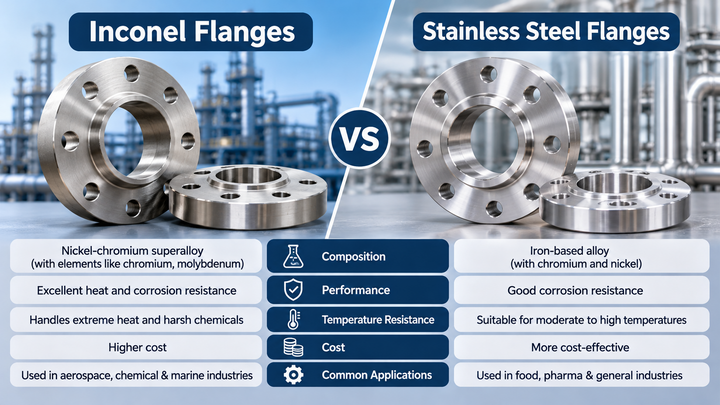
Inconel flanges deliver greater strength and heat resistance compared to stainless steel flanges in extreme industrial piping applications. Stainless steel is cost-effective and corrosion-resistant; however, Inconel is superior at extreme temperatures and pressures.
Inconel and stainless steel are some of the most relied-upon families of corrosion-resistant alloys for many demanding industrial applications. Both are ideal for critical infrastructure, but the best choice actually comes down to the maximum operating temperature, corrosion environment, mechanical requirements, and the conditions on the factory floor in the real world.
Inconel flanges are high-performance piping components made from nickel-chromium-based superalloys. Inconel 600, 625, and 718 are the most often utilized grades. These flanges are intended for use in demanding working conditions. They offer superior mechanical strength, oxidation resistance, and structural integrity in harsh thermal stress, high-pressure loads, and aggressive corrosive chemical or marine environments where typical stainless steels fail.
This sophisticated gear is used in heavy industry, where failure of equipment is simply not an option. Typical applications are:
Chemical and petrochemical processing plants where hot volatile acids are being handled.
Power-generation systems in severe superheated steam pressure.
Heat-treatment and heavy furnace equipment exposed to direct continuous flame.
Applications in aerospace when high thermal yield strength is required.
Oil and gas systems subjected to high chlorides and severe sour gas conditions.
Inside high-temperature, corrosive process pipes in heavy refineries.
Because these settings are so diverse, it is important that the specific Inconel grade be matched specifically to the service environment to assure safe containment.
Inconel is the ultimate expert, while Stainless Steel Flanges are the workhorses of modern industry. The corrosion resistance of the core of these forged piping components is based on chromium metallurgy. Chromium forms a small passive oxide layer that self-heals and protects the underlying steel from rapid corrosion and atmospheric deterioration.
Commonly utilized grades are 304, 304L, 316, and 316L. These are the ones often used by industry specialists. These materials provide a very useful combination of baseline corrosion resistance, mechanical strength, clean fabricability, and wide global availability. They are the common basis for normal industrial pipe applications around the world.
These adaptable components help many worldwide manufacturing industries each and every day. They are widely used in:
Chemical process plants for industrial acids and solvents.
Food and beverage processing plants require strict, easily cleanable sanitary standards.
Pharmaceutical plants for complete fluid purity in drug production.
Water and big municipal wastewater treatment plants.
General oil and gas surface piping systems.
Utility networks and general industrial process lines.
Engineers typically specify 304/304L for baseline resistance to ambient moisture. They are upgraded to 316/316L when the fluid has higher chloride content or if the plant is in a coastal location.
The basic distinction between these two metals is the element they are made from. Stainless steel is primarily based on iron, which is then alloyed extensively with chromium and variable levels of nickel. Inconel flips this recipe on its head. The principal base element is nickel, which is alloyed with chromium, molybdenum, and other minor elements to form a very stable heat-resistant superalloy.
Stainless steel takes moisture, rain, and ordinary industrial chemicals very well. However, it is susceptible to localized pitting and stress corrosion cracking in highly chloride or highly acidic conditions. Inconel, in contrast, has substantially better resistance over a much wider range of hostile chemicals. It is totally resistant to chloride-ion stress-corrosion cracking and safely withstands strong reducing acids.
Conventional austenitic stainless steel loses considerable strength and scales fast above around 1500°F (815°C). Extreme heat is where Inconel excels. It is dimensionally stable, resists severe oxidation, and retains shape in settings up to 2000°F (1093°C) depending on the grade used.
Both metals have good baseline mechanical strength at room temperature. The true discrepancy is under thermal stress. Inconel retains its high tensile and yield strength at increasing temperatures, but stainless steel will experience significant creep, drooping and ultimately mechanical deformation when pushed to carry heavy loads under intense heat.
Stainless steel is not that bad on the shop floor. It has good formability and can be cleanly welded using normal processes. Inconel is a big problem for the machinist. The superalloy work-hardens rapidly in machining and can damage regular cutting tools. It involves very regulated, slow-speed machining techniques and very sophisticated welding protocols.
Inconel flanges are much more expensive than their typical stainless steel counterparts due to their high nickel content and the complicated, energy-intensive manufacturing procedures involved. Stainless steel, however, is relatively cheap and may be sourced instantly from international vendors in practically every common size.
|
Parameter |
Inconel Flange |
Stainless Steel Flange |
|
Alloy Base |
Nickel chromium |
Nickel-iron-chromium |
|
Resistance to Corrosion |
Excellent in strong acids and heavy chlorides |
Excellent for general industrial and atmospheric conditions |
|
Performance in High Temperatures |
Good; Withstands extreme temperatures extremes |
Moderate; loses strength at hot temperature |
|
Strength, Mechanical |
High strength and resistant to creep at high heat |
Hard at normal temperature; melts at intense heat |
|
Chemical Resistance |
Excellent resistance to stress corrosion cracking and sour gas |
Susceptible to chloride attack (pitting and cracking) |
|
Manufacture |
Hard to machine; work hardens quickly |
Machinable, chopped, welded and formed easily |
|
Price |
High first costs of material and manufacturing |
Economic and affordable |
|
Common Usage |
Severe aerospace, chemical & high-temp furnace pipework. |
Food, water, pharma and general chemical processing |
Establish the exact continuous and peak operating temperatures that will occur inside the pipeline first. Consider how drastic changes in temperature will affect raw mechanical strength and baseline corrosion resistance.
A rigorous analysis of the process fluid is necessary. Consider exposure to aggressive acids, concentrated chlorides, heavy alkalis, raw seawater, sour gases, and other process chemicals. The right alloy grade for the real chemical environment will prevent devastating failures in mid-production.
Always check the required pressure class, the nominal pipe size, external structural loads, and the dynamic working conditions. The flange specification must match the total piping system rating to prevent catastrophic blowouts under severe mechanical stress.
Evaluate shop welding, field machining, physical assembly, and long-term maintenance requirements. Another consideration is the availability of qualified fabrication and installation resources. Not every welding team is certified or equipped to securely weld Inconel.
Smart buying isn’t just about the price you pay up front. Combine material cost with estimated service life, scheduled maintenance, replacement frequency, and the severe financial effect of unexpected plant downtime. Compare the initial material cost with expected service life, maintenance requirements, replacement frequency, and the consequences of unplanned downtime. A higher-cost alloy can be justified when its corrosion or high-temperature performance reduces maintenance or replacement requirements over the intended service period.
Flanges, weld neck
Flanges, slip-on
Blind Flange
Socket welded flanges
Flanges, Threaded
Lap joint flange
Note that the precise type of flange must be chosen according to the mechanical connection design, system pressure, operating temperature, and the real field piping requirements.
The choice between Inconel and stainless steel flanges depends on the service temperature, corrosion environment, pressure, mechanical requirements, applicable standards, and overall cost. Stainless steel suits many general industrial applications, while selected Inconel grades are considered for services requiring higher-temperature strength or resistance to specific corrosive environments. Buyers evaluating these materials can use platforms such as The Piping Mart, a B2B portal that connects buyers with suppliers, manufacturers, and exporters, to identify relevant sources based on their required grade, flange specification, and service conditions.