
Posted by Vikram Sharma
Filed in Arts & Culture 10 views
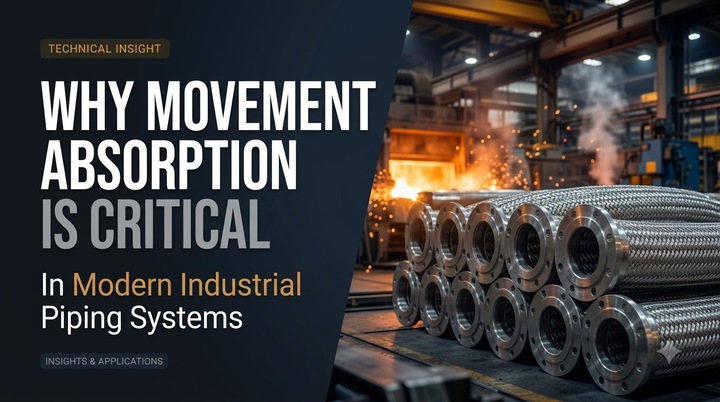
Industrial piping systems are constantly subjected to movement caused by thermal expansion, vibration, pressure fluctuations, and equipment operation. Movement absorption is a key design consideration for improving system reliability, safety, and equipment life. Engineers frequently use SS Braided Hose Pipes to accommodate these continuous movements. Proper compensation methods prevent structural breakdown and reduce material fatigue across active processing networks. This basic engineering practice ensures continuous plant operations without causing sudden mechanical disruptions or catastrophic material failures.
Industrial piping systems experience several physical shifts during normal daily operation. Axial movement happens when a pipe stretches or compresses directly along its straight centerline. Lateral displacement pushes the fixed pipe sideways. Angular movement bends the connections at specific angles. Heavy rotating equipment generates constant mechanical vibration that travels through the rigid lines.
High heat and cooling cycles cause regular thermal expansion and contraction in the metal structures. Engineers must account for these displacement forces during the initial design phase. Ignoring these physical shifts guarantees that rigid networks will eventually buckle, crack, or break under the accumulated stress.
Failing to manage displacement creates severe operational challenges in industrial environments. The resulting excessive stress on pipes and Pipe Fittings compromises the entire structural frame. This tension causes immediate flange leakage and forces equipment misalignment at critical connection points. These factors accelerate premature joint failure. Facilities then face increased maintenance demands and costly unplanned downtime to replace broken parts. Unmanaged forces also introduce severe safety risks in critical process industries handling hazardous materials. Overlooking movement absorption degrades plant productivity and exposes personnel to dangerous pressure blowouts or spills.
Engineers install specific components to resolve these exact displacement problems. These metal hoses provide necessary flexibility without compromising pressure performance during heavy operations. They deliver effective vibration isolation while acting as a reliable compensation method for thermal expansion along straight pipe runs. This absorption mechanism guarantees full protection of pumps, compressors, valves, and turbines connected to the main lines. Using these flexible sections translates into reduced mechanical stress on connected equipment. The corrugated inner core bends safely while the outer stainless braid prevents elongation under high internal pressure.
Selecting proper absorption components requires careful technical evaluation of several operating parameters. Engineers must analyze specific physical requirements before finalizing any permanent industrial piping installation.
Designers must calculate whether the expected displacement is lateral, angular, or axial. The direction and frequency of the physical shifting dictate the exact installation geometry required for safe plant operation.
Engineers evaluate the maximum internal pressure levels within the system. The selected metal hose assembly must withstand normal working pressure and unexpected spikes without suffering burst failures or sudden leaks.
System temperature dictates material viability. The stainless steel component must maintain its mechanical strength and flexibility when exposed to extreme process heat or cryogenic cooling cycles during daily plant operations.
Metallurgical compatibility remains essential for long service life. Engineers typically specify grades like 304, 316, or 321 stainless steel depending on the specific corrosive nature of the transferred process fluid.
The inner diameter dictates the flow rate, while the total length determines the movement capability. Insufficient length restricts necessary bending, while excessive length causes destructive vibration and rubbing against structures.
Connecting points require precise matching to existing plant infrastructure. Buyers select flanged, threaded, or welded terminations to ensure permanent sealing integrity under continuous thermal cycling and heavy mechanical displacement loads.
Available physical space dictates the routing configuration. The installed component must stay within its published minimum bend radius to prevent destructive metal fatigue and premature rupture during active plant service.
Effective absorption solves critical problems across various demanding sectors. Pump discharge and suction lines require isolation to prevent vibration from destroying fixed headers. Steam pipelines experience massive thermal expansion that will break rigid anchor points without flexible joints. Chemical processing plants and oil and gas process piping demand secure movement accommodation to prevent hazardous leaks. HVAC systems use flexible components to isolate compressor noise and shifting. Power generation facilities alongside marine and offshore installations require these robust systems to handle constant mechanical vibration and extreme structural motion.
Proper installation and maintenance routines guarantee the reliability of flexible components. Operators must follow strict engineering guidelines to achieve the maximum possible functional service life.
Correct hose routing prevents mechanical interference with nearby equipment and ensures the natural bending plane aligns directly with the expected physical displacement.
Avoiding overextension and twisting during installation stops severe torsional stress that rapidly damages the internal corrugated core under pressure.
Supporting connected pipework with appropriate rigid anchors eliminates unnecessary static weight from pulling downward on the flexible assembly.
Routine inspection protocols help maintenance teams identify early signs of exterior braid wear or minor fluid weeping before major ruptures occur.
Timely replacement in demanding service conditions prevents unexpected operational shutdowns by swapping fatigued components based on strict preventative schedules.
Effective movement absorption is fundamentally essential for maintaining complete piping integrity, reducing heavy maintenance costs, and extending overall equipment life. Selecting the appropriate stainless steel braided hose pipe depends entirely on understanding the specific type of movement, prevailing operating conditions, and overall system design. Integrating these flexible components properly secures industrial infrastructure against the destructive physical forces generated during continuous daily plant operations.