
Posted by Vikram Sharma
Filed in Arts & Culture 9 views
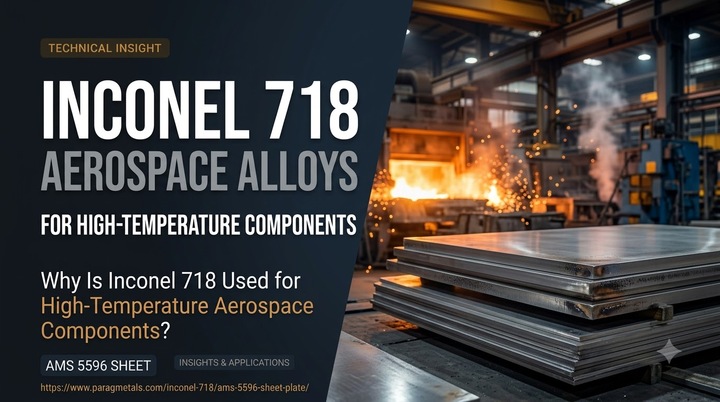
Aerospace engineering requires materials that survive hostile environments. Jet engines generate extreme thrust through high-pressure combustion. Standard steel and aluminum alloys degrade rapidly. Standard stainless steels lose their tensile strength and suffer from severe oxidation when exposed to jet fuel combustion gases. Engine operating temperatures frequently exceed 1200°F (650°C). Inconel 718 is a nickel-chromium-molybdenum superalloy formulated specifically to survive this environment. The aerospace industry relies heavily on Inconel 718 High-Temperature Applications because the alloy maintains its structural integrity. It resists metal fatigue and environmental degradation during long flights. Engineers specify this material for turbine engines when structural failure would cause catastrophic engine loss.
High-temperature strength is the primary reason engineers select this alloy. Inconel 718 maintains its mechanical properties up to 1300°F (704°C). The material relies on precipitation hardening. Niobium and titanium additions create a gamma double-prime precipitate structure within the nickel matrix during heat treatment. This structure locks the crystal lattice in place. The material stays hard under intense heat.
Creep and fatigue resistance dictate the physical lifespan of turbine components. Creep is the permanent plastic deformation of a metal under constant stress at high temperatures. Centrifugal forces in rotating engine parts cause creep. Inconel 718 resists creep rupture. The fatigue resistance handles the extreme cyclic loading of engine startup, cruising, and shutdown. The material handles thermal fatigue without cracking.
Corrosion and oxidation resistance are mandatory. Jet fuel combustion creates harsh chemical byproducts. The nickel and chromium content forms a protective oxide layer on the metal surface. This prevents scaling at elevated temperatures. It protects the base metal from corrosive exhaust gases.
Weldability separates Inconel 718 from other high-strength superalloys. The precipitation hardening response of the niobium-rich matrix prevents post-weld strain-age cracking. Fabricators weld complex aerospace assemblies and heat-treat them later without significant risk of weld zone cracking. Fabricators use Inconel 718 Sheet to build large engine structures using standard welding techniques.
Several critical areas within aircraft engines utilize Inconel 718 Aerospace Components. The high-pressure compressor section requires high tensile strength. Compressor blades and stator vanes face intense aerodynamic loads and heat compression. Inconel 718 handles the physical stress without deforming.
Turbine disks and shafts rely heavily on the alloy. These rotating components endure massive centrifugal forces. A structural failure here destroys the engine. The material's high yield strength prevents the turbine disks from expanding outward into the engine casing.
Combustion cases and exhaust ducting use flat-rolled sheet material extensively. These stationary parts contain the expanding superheated gases. They withstand thermal cycling and oxidation over thousands of flight hours.
Thrust reversers and internal engine seals operate directly in the hot exhaust stream. Fasteners made from this material hold the engine sections together. High-temperature bolting requires low relaxation rates. The bolts maintain clamping force. Inconel 718 fasteners do not stretch permanently under continuous tension and heat.
Aerospace material specifications define the exact chemical and mechanical requirements for alloys. AMS 5596 is the governing specification for Inconel 718 supplied as sheet, strip, and plate. The specification controls the manufacturing route at the mill. It requires the material to be supplied in the solution heat-treated condition. Vacuum induction melting is mandatory.
Specification-controlled material gives engineers predictable baseline properties. If a fabrication shop orders AMS 5596 Sheet, they know exactly how the metal will behave. Engineers use this sheet for fabricating ducting, transition liners, and brackets. The specification mandates a specific grain size and maximum hardness limits. This guarantees the material responds correctly to cold forming and welding.
Heavier sections require thicker AMS 5596 Plate. Manufacturers machine this plate into structural rings and brackets. Not every Inconel 718 component follows this specification. Forgings and round bars follow different AMS numbers. AMS 5596 only covers flat-rolled products. It ensures the mill follows strict testing for room temperature tensile strength and yield strength before shipping.
Buyers and engineers evaluate several technical variables before ordering material. Thickness and dimensional tolerances affect the final assembly weight. Aerospace weight limits are strict. Minor thickness deviations add unwanted weight.
Material condition matters for fabrication. AMS 5596 dictates a solution-annealed state. This condition provides maximum formability. The fabricator performs the final precipitation hardening heat treatment only after shaping and welding the part.
Mechanical requirements must align with the service temperature. The mill performs stress-rupture tests at 1200°F (650°C) under high stress loads. The material must survive a specific number of hours without breaking to pass certification.
Fabrication requirements dictate the surface finish of the sheet. Welding processes need clean surfaces. Poor surface conditions cause weld defects and porosity.
Certification and traceability are non-negotiable. Every piece of sheet or plate needs a certified material test report. The documentation tracks the metal back to the original melt lot. This proves compliance with chemical composition limits.
Standard stainless steels and titanium alloys serve well in many industrial uses. Aerospace gas turbines push past their limits quickly. Standard metals melt, oxidize, or deform under the physical loads. The following table highlights basic operational differences. Material selection depends on the specific service temperatures and mechanical loads of the engine section.
|
Property / Feature |
Inconel 718 |
300 Series Stainless Steel |
Titanium Alloys (e.g., Ti-6Al-4V) |
|
Max Service Temp |
Up to 1300°F (704°C). |
Under 800°F (426°C). |
Up to 750°F (400°C). |
|
High-Temperature Strength |
Retains high tensile strength in heat. |
Loses strength rapidly at elevated temperatures. |
High strength at lower temperatures. |
|
Corrosion/Oxidation Resistance |
Resistant to jet exhaust gases. |
Susceptible to scaling and oxidation. |
Vulnerable to oxidation at high heat. |
|
Fatigue Performance |
Excellent under cyclic thermal and mechanical loads. |
Moderate fatigue resistance. |
Good at lower temperatures. |
|
Fabrication Considerations |
Good weldability, requires complex aging heat treatment. |
Easily welded and formed without heat treatments. |
Requires inert atmosphere for welding. |
|
Creep Resistance |
Exceptional resistance to plastic deformation under load. |
Poor resistance to creep deformation above 1000°F. |
Low resistance to creep at turbine operating temperatures. |
Inconel 718 handles the physical and thermal demands of gas turbine engines. The alloy resists creep, oxidation, and fatigue at 1300°F. This keeps critical components intact during flight. Its weldability allows for practical manufacturing of complex engine structures without strain-age cracking. AMS 5596 Sheet and AMS 5596 Plate provide a standardized material source for aerospace fabricators. Sticking to this specification ensures the raw material meets mechanical baselines before forming or welding begins. Engineers rely on these products to build the ducting and structural rings that keep aircraft engines operating safely.